Wednesday, 22 February 2012

Road to Vang Vieng


Just before leaving Luang Prabang - the street in front of my Guesthouse.
Backpacks being secured to the beauty concept carrier rack on our Hyundai Minivan.
Classic bathroom at a rest stop.
First stop at a string of restaurants high up on a mountain ridge.
Armed Lao soldier shopping by the junction in Phou Khoun.
Woman soldiers by the junction in Phou Khoun.
On the long and winding road
Controlled fire in the mountains
Vang Vieng sunset.

LEFT LUANG PRABANG before mid-morning for the 220 kilometre journey to Vang Vieng. The minivan driver made three stops along the way. The journey on a narrow highway, with numerous gravel patches, plus slower vehicles, made for a trip of over seven hours. En route we stopped on a high ridge for lunch. An hour later a passenger asked for a washroom stop in Phou Khoun. It was unattractive junction town also high up in the mountains. Saw a few soldiers in town. One was walking with a rifle in one hand and a shopping bag in the other. Back in the 90s there was still a Hmong (national minority group) insurgency up here in these mountains which included bandits stopping traffic along this highway route. This has all ended with an amnesty offered by the Lao government. Also noticed several convoys of army trucks which might, or might not, have had something to do with all this.

In the late afternoon Vang Vieng was full of young packpackers, just as I had heard and the place felt like a one big party scene. This evening patrons were congregating in bars along the crooked street, watching sitcoms like "Friends" on big screens, as the sprawled out. The open air lounges were even equiped with reclining seats for chilling. I also heard that some bars here sell so-called happy drinks that are laced with anything from marijuana through magic mushrooms to amphetamines. Because the fan in my room ran all night, it cancelled out all the party noise from outside. It would be an understatement to say that Vang Vieng was completely weird.


Tuesday, 21 February 2012

Last Day in Luang Prabang


Pathana Boupha Antique House with "old" Buddhas and family photos.
Worshippers at the temple.
Tamarind pods, Mangosteen and some fruit I can't identify.
One plate full for 10,000 kip ($1.25) at the Night Food Market.
Food stall by the Mekong River.
Back of Sim (Ordination hall) and corner of a Haw (compact chapel) at Wat Xieng Thong.
Inside the Sim at Wat Xieng Thong.
Bougainvillea and Hohng Kep Mien (carriage house) at Wat Xieng Thong courtyard.


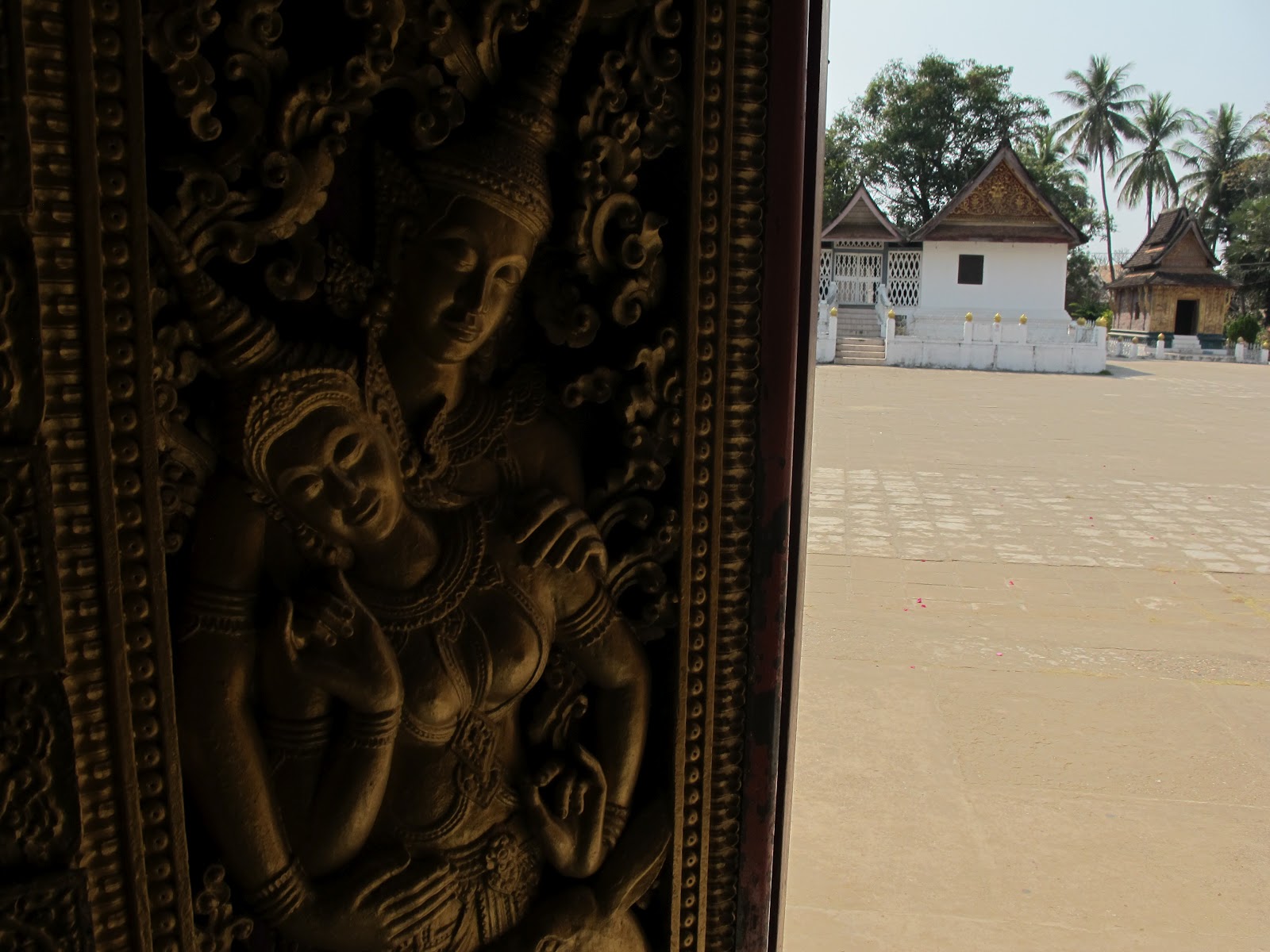
Inside the Hohng Kep Mien, looking through entrance door, to the Wat Xieng Thong courtyard.
Monks dishes at Wat Xieng Thong.
Monks bath tank at Wat Xieng Thong.
French colonial architecture on Sisavangvong Street.
Bougainvillea and flag.
AT THE END of a one week stay in Luang Prabang here is a posting short on text but with images from the last two days here. The journey continues tomorrow to Vang Vieng and in a few more days to Vientiane, the Laotian capital.

Sunday, 19 February 2012

On the Far Shore

Ferry to Muang Chomphet on the far shore from Luang Prabang.
Wat Long Khun as seen through a screen of Bourgainvillia.
Porch of Wat Long Khun
Wat Long Khun interior with murals.
Wat Long Khun with mural detail.
Detail from entrance to Wat Long Khun.
Walking meditation hallway for future Laotion kings at the Wat Long Khun.
Monks quarters at Wat Long Khun.
Novice monks at Wat Long Khun.
Tham Sakkalin is a cave containing some broken relics and is adjacent to Wat Longkhun.
Some 123 steps above the lane Wat Chomphet offers a rewarding view of Luang Prabang.
Wat Xieng Maen near the ferry.
On the lane back to the ferry.
Ferry back to Luang Prabang.

ON THE FAR SHORE of the Mekong River is Chomphet District, which can be reached by a vehicle ferry, or passenger boats. On a cloudy morning I left the hyper-active tourist scene of Luang Prabang for a quiet day, visiting a string of wats or monastery temples, connected by a lane that eventually turned to a dirt track. Of the three locations Wat Long Khun, the last stop, was probably the most interesting. Otherwise known as the Monastery of the Happy or Blessed Song, it is across the Mekong River from the temple district of Luang Prabang. First built in the 18th century it has played an important role for Laotian royalty. From early on Long Khun has been a retreat centre for the spiritual preparation of the king-designate, who would practice meditation and ceremonial bathing, prior to his coronation. With the communist revolution of 1975 the Laotian monarchy was dissolved and the monastery slowly fell into disrepair. Today monks live here so the grounds and buildings are at least maintained in a minimal sort of way. Great Saw Palmetto Palms and Bougainvillea add colour and texture to the grounds. As for the striking murals, depicting the life of Buddha, one can be thankful that they have not been garishly restored. Unfortunately the elements and some vandalism from the revolutionary period have taken its toll.

Other stops included the Wat Chomphet and Wat Xieng Maen. I took a little ferry back and was in town by late afternoon.


Saturday, 18 February 2012

Pak Ou Caves

Setting out for the Pak Ou Caves
Following the Mekong shore.
Dock in front of Ban Xang Hay village
Mekong River and Ban Xang Hay shore
Early stage in the Rice Liquor process
Lao Lao rice liquor with the added benefit of a Cobra.
Stairs just below the upper cave.
Buddhas inside the Upper Cave at Pak Ou.
Lower cave at Pak Ou.
Lower caves at Pak Ou.

PAK OU CAVES are upstream on the Mekong River from Luang Prabang. A small tour boat took six of us there, stopping en route so we could see the rice whiskey producing village of Ban Xang Hay. It was a short visit but but even a brief glimpse of Lao Lao being made was of interest. One could only presume that the bottles with the Cobras in them were intended as some kind of tonic.

We continued on to the Pak Ou Caves and when we arrived many other small boots were already there tied-up at the bottom of a sheer limestone cliff. The karst formation contained two caverns used for Buddhist worship: the upper and lower caves. The steps to the higher shrine was a sweaty climb in midday heat, up a long flight of steps.. Once at the upper caves one passed through a wooden portal in the entrance. Beyond was a 50 metre passage leading to groups of Buddha in the gloom.

Returning to the river the lower caves were partially just a vast overhang but the steeply inclined floor was just bursting with Buddhas, possibly thousands of them, in all shapes, sizes and states of condition. Despite the throngs of tourists this trip was completely rewarding and hopefully the pictures will convey a little bit of the magic from this tour.

Laung Prabang


Sisavangvong Street in the heart of Luang Prabang.
Orchids against the backdrop of a hammer and sickle flag.
Shop owner with silk scarves.
Citroen Traction Avant on Sisavangvong Street.
Tree with with orange blooms and monks studying beneath it.
Buddhist temple of Wat Ho Pha Bang.
French colonial era window detail.
Late afternoon light on the Mekong River.
Some of the school girls have red scarves, reflecting Laos's communist beliefs, at least in theory.
Grilled fish vendor.
Evening view from the pagoda-crowned hill of Phu Si..
Fruit shake vendor.
Evening view of the Mekong River.
MY WEEK in Luang Prabang was a wonderful opportunity to chill and soak up the ambience of this historical town. The place was full of atmosphere. Situated on the banks of the Mekong River, it was a UNESCO World Heritage Site for good reason. Luang Prabang was the setting for many Buddhist temples and French colonial buildings. In the late afternoon light, the town looked absolutely magical. This was one of the few places on the trip, where i left with some regret.

Some useful links:
Luang Prabang - Wikipedia, the free encyclopedia
Luang Prabang Travel Information and Travel Guide - Laos - Lonely Planet